
Computer controlled RC toy car (RoboCar)
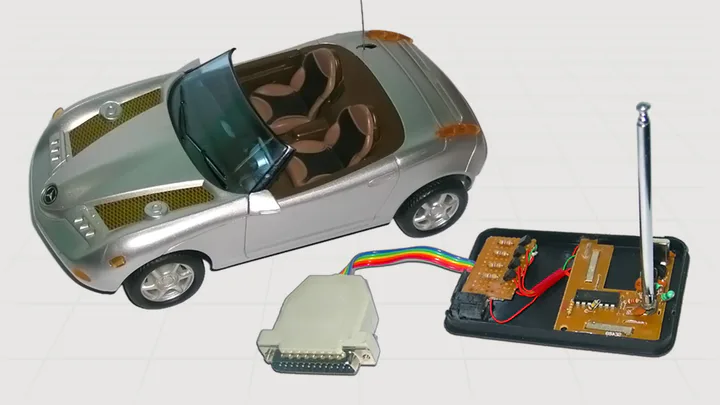
In high school, I converted an RC toy car into a PC-controlled vehicle operated by keyboard like a video game. Using a C program and the parallel port, I built an early PC-to-hardware control system years before hobbyist microcontroller boards made this type of project widely accessible.
Story
In my senior year at Notre Dame College in Dhaka, I converted a basic RC toy car into a PC-controlled vehicle for the 2003 science fair. The car’s radio transmitter connected to the computer’s 25-pin parallel port (LPT1) through four NPN switching transistors, one for each direction. Each transistor acted as an electronic switch, closing the corresponding joystick contact when the parallel port pin went high.
I wrote the control software in C to work on both DOS and Windows, so the setup ran regardless of the host OS. I also replaced the transmitter’s battery supply with a DC barrel jack for stable, uninterrupted power during demos. From the keyboard, the car responded like a game controller.
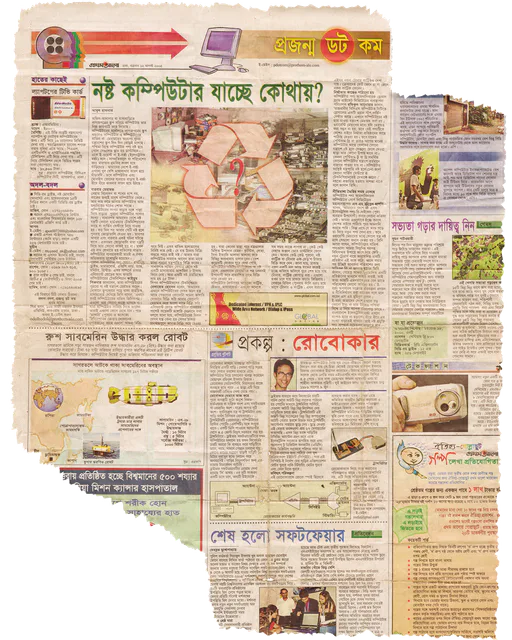
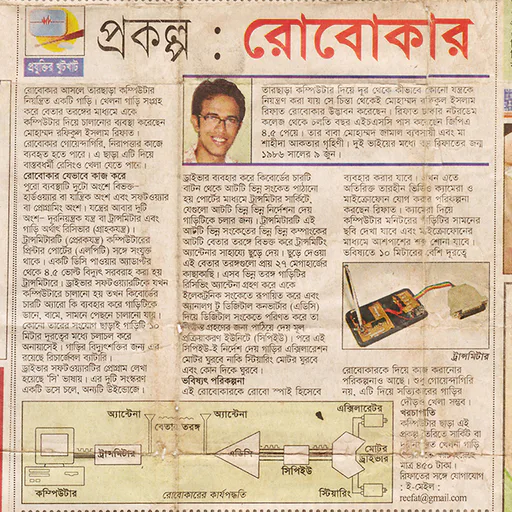
The project won 3rd prize at the science fair and was later covered by Prothom Alo. More than the recognition, it gave me my first direct experience of writing software that moved something physical in the world. That feeling shaped the next decade of my work.
He has subjected for you whatever is in the heavens and whatever is on the earth, all from Him. Surely in this are signs for people who reflect.
Impacts
- Won 3rd prize at the Notre Dame College Science Fair and was later featured in Prothom Alo, Bangladesh’s largest daily newspaper
- Demonstrated real-time PC-to-hardware wireless control in 2003, years before microcontroller hobbyist boards made this type of project approachable
Challenges & Solutions
Challenges
- Understanding parallel port behavior with no documentation or community resources available in Dhaka at the time
- Controlling four directional inputs on the RC transmitter from only four digital pins without damaging the transmitter’s internal circuitry
Solutions
- Reverse-engineered the LPT1 pin behavior through direct experimentation and wrote C programs to control it on both DOS and Windows
- Wired four NPN switching transistors between the parallel port data pins and the transmitter’s joystick contacts, mimicking button presses electrically without any direct connection between the PC and the RF hardware