
Search engine rank optimizer (SERO)
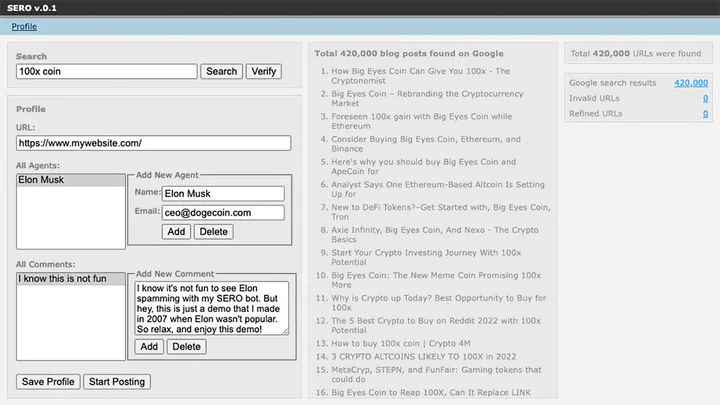
I built SERO to automate SEO link-building for Pechali.com. It queried Google, identified WordPress sites with unprotected comment forms, and submitted keyword-anchored backlinks automatically, improving rankings before anti-spam measures caught up.
Story
In 2007, while scaling Pechali.com, I ran into the slow reality of manual link-building. Writing guest content and placing backlinks one site at a time was effective but could not keep pace with the growth I needed.
I built SERO (Search Engine Rank Optimizer) to automate it. The tool queried Google with target keywords, parsed the search results for WordPress posts, and filtered for comment forms that were still open. It then submitted a comment using the target keyword as the author name and the site URL in the website field. WordPress turns the author name into a clickable link pointing to that URL, which is exactly what a backlink needs to be. Once Google crawled it, the link counted.
SERO remained effective for several years and produced real gains in keyword rankings and referral traffic for Pechali.com. Eventually Google improved bot detection and WordPress widely adopted Akismet and CAPTCHAs, which ended the method’s effectiveness. Building SERO gave me a close understanding of how crawlers evaluate and weight links, knowledge that shaped every SEO decision I made afterward.
Do not mix truth with falsehood or hide the truth knowingly.
SERO was experimental. When Akismet, CAPTCHAs, and stricter bot detection ended the method, I did not go looking for the next loophole. I enjoyed the project for what it taught me about scraping, parsing, and how crawlers weight links. The verse above is how I look back at that period.
Impacts
- Drove measurable keyword ranking improvements and sustained referral traffic growth for Pechali.com over several years
- Built a full scrape-to-submit pipeline using only PHP and cURL, covering Google search parsing, DOM filtering, and form automation with no external libraries
Challenges & Solutions
Challenges
- Manually identifying WordPress sites with open comment forms at the scale needed for effective link-building was not viable
- Both the Google scraping step and the form submission step risked triggering bot detection
- Comments needed to produce a clickable, keyword-anchored backlink rather than plain unlinked text
Solutions
- Automated Google search queries for target keywords, parsed the HTML results using RegExp and DOM traversal, and filtered for WordPress posts with accessible comment forms
- Rotated user-agent strings and randomized submission timing to distribute requests in patterns that resembled normal browsing
- Submitted the target keyword as the commenter’s author name with the destination URL in the website field, exploiting the standard WordPress author-link pattern to generate crawlable backlinks